Introduction
In global logistics and containerized transportation, few pieces of equipment are as essential—but often overlooked—as the chassis trailer, also known as the container chassis. These skeletal steel trailers form the backbone of modern cargo movement, enabling containers to travel efficiently between ships, ports, terminals, warehouses, and inland destinations.
Yet many fleet owners, freight forwarders, and logistics managers still ask an important question:
“What exactly is a chassis trailer, and why is it so critical for container transport?”
Container chassis play a fundamental role in keeping supply chains moving. Without them, containers cannot be transported safely on roads. As global trade grows—especially across Africa, the Middle East, Southeast Asia, and other emerging markets—the demand for reliable chassis trailers continues to rise.
This article provides a complete guide to understanding chassis trailers. You will learn:
-
What a chassis trailer is and how it works
-
The different chassis types and their features
-
Key functions and advantages in logistics
-
How to choose the right model for your fleet or business
-
Ownership vs leasing considerations for operators
Whether you are a port operator, trucking company, freight forwarder, or importer/exporter, this guide will help you make informed decisions about chassis trailers.
What Is a Container Chassis / Chassis Trailer?
Definition
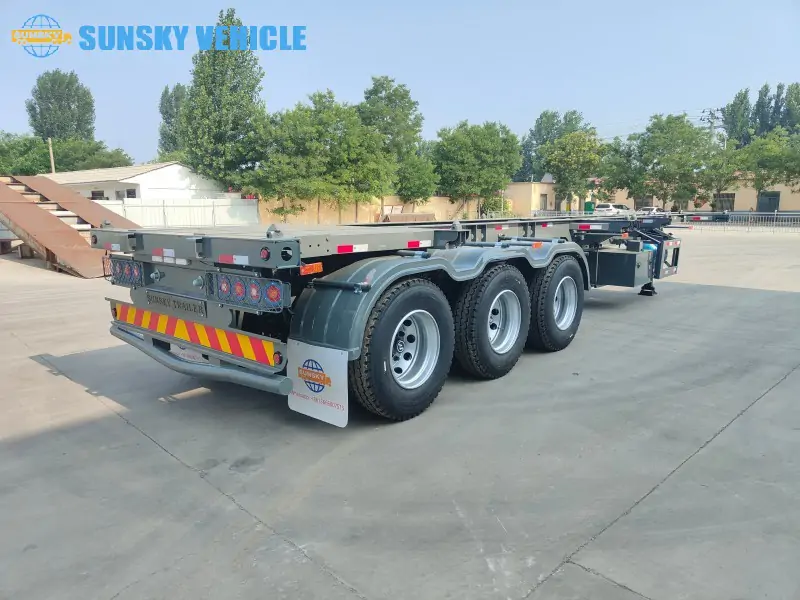
A container chassis, also known as a chassis trailer, is a specialized semi-trailer engineered specifically for transporting ISO shipping containers on public roads. Its primary function is to provide a safe, stable, and efficient platform for carrying containers of different standard sizes—including 20ft, 40ft, and 45ft units.
Unlike general-purpose trailers, the container chassis is purpose-built for intermodal logistics, enabling seamless movement of containers between ships, ports, rail terminals, warehouses, and inland destinations. It forms the key connection between maritime and land-based transportation.
Key Structural Components
A high-quality chassis trailer is made of several essential components that work together to ensure safety, durability, and efficient container transport.
1. Steel Frame (Main Beam Structure)
The backbone of the chassis.
-
Constructed from high-strength steel (e.g., Q345/Q550).
-
Designed to withstand heavy loads and rough road conditions.
-
Available in fixed, gooseneck, or extendable configurations.
2. Axles & Wheels
Support the trailer’s load and provide mobility.
-
Common setups: 2-axle, 3-axle, or 4-axle depending on regional road regulations.
-
Heavy-duty axles (e.g., FUWA, BPW) improve stability and durability.
3. Suspension System
Absorbs shock and ensures smooth transportation.
-
Mechanical suspension for rugged roads
-
Air suspension for long-distance and sensitive cargo
4. Braking System
Ensures road safety during transport.
-
Equipped with ABS for anti-lock braking
-
Complies with international road safety standards
5. Twist Locks (Container Locking Mechanism)
Critical safety components that secure the container.
-
Located at the corners of the chassis
-
Allow fast and safe locking/unlocking of containers
-
Available in manual or automatic types
6. Electrical & Lighting System
Provides visibility and complies with road traffic regulations.
Includes:
-
LED tail lights
-
Turn signals
-
Reflectors
-
Electrical wiring (usually 24V systems)
7. Landing Gear
Supports the chassis when it’s not connected to a tractor head.
-
Heavy-duty, adjustable
-
Ensures stability during parking and loading/unloading
These components work together to create a trailer that is strong, stable, safe, and capable of handling the heavy demands of container shipping.
Relationship to a Skeletal Trailer
A container chassis is essentially the same equipment commonly referred to as a skeletal trailer in many regions.
Both terms describe the same type of trailer—a minimalistic, open-frame structure built exclusively for container transport.
Chassis Trailer vs Skeletal Trailer — Are They Different?
| Term | Region Commonly Used | Meaning |
|---|---|---|
| Chassis Trailer / Container Chassis | North America & Asia | Standard name for container-carrying trailer |
| Skeletal Trailer / Skeleton Trailer | Europe, Middle East, Africa | Emphasizes the “open-frame” or “bare-bone” structure |
Key Point:
➡️ Whether you call it a chassis trailer or a skeletal trailer, it refers to the same piece of equipment with the same purpose:
transporting shipping containers using a strong, open-frame steel structure with twist locks.
Some skeletal trailers may have slightly different frame shapes or additional reinforcements, but the core function and design remain identical.
Types of Container Chassis
Container chassis trailers come in several structural configurations, each designed for specific container sizes, cargo types, and transportation environments. Choosing the right chassis type can significantly improve loading efficiency, operational safety, and cost control. Below are the most common types used globally.
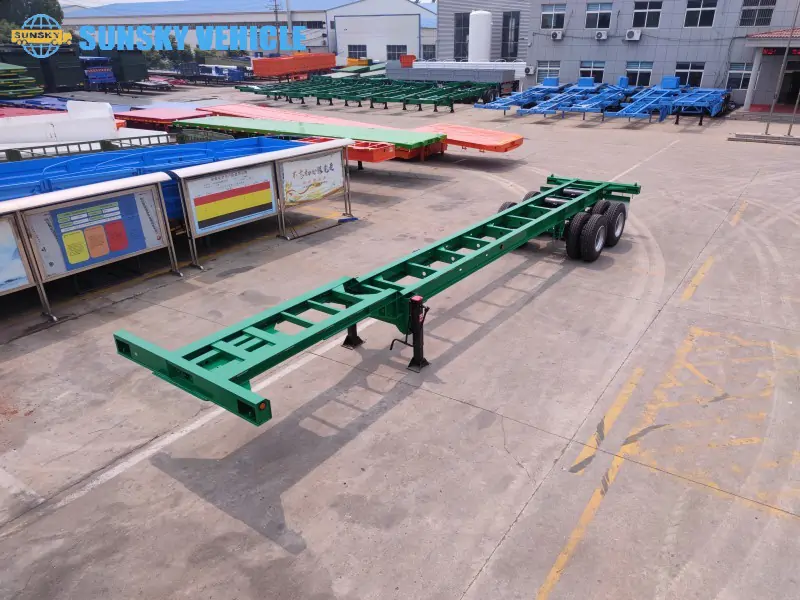
1. Fixed Chassis (Fixed-Length Container Chassis)
A fixed chassis is designed with a single, non-adjustable frame length.
It is engineered specifically to carry one standard container size—typically:
-
20ft fixed chassis
Key Features
-
Strong, simple, and highly durable structure
-
No moving parts → lower maintenance cost
-
Ideal for ports, short-haul (drayage), and dedicated container routes
Best For
-
Fleets transporting consistent container sizes
-
High-volume port operations
-
Budget-conscious operators seeking minimal maintenance
Fixed chassis trailers are extremely popular because of their reliability and low cost of ownership.
2. Extendable Chassis (Telescopic / Sliding Chassis)
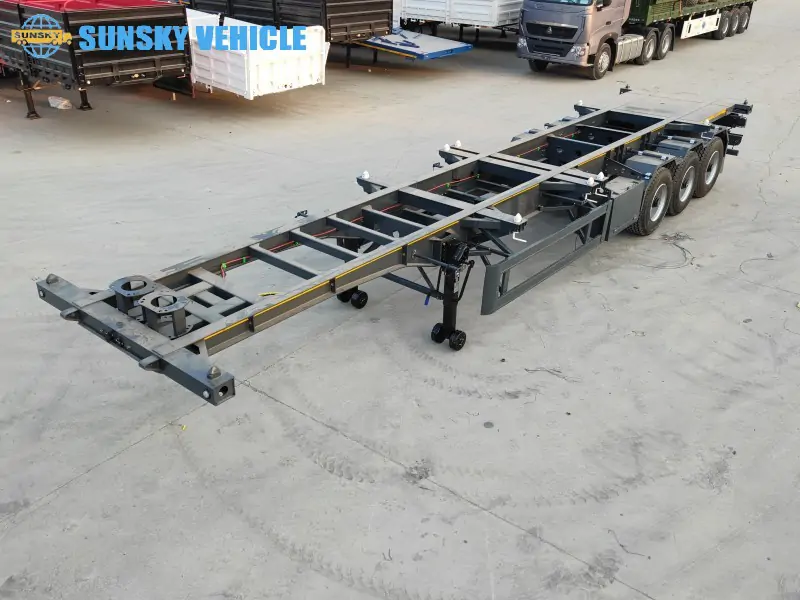
An extendable chassis—sometimes called a telescopic chassis—is designed with sliding or extendable frame sections that allow it to adjust between multiple lengths.
Typical Configurations
-
20ft → 40ft
-
20ft → 40ft → 45ft
-
Multi-position locking for various container types
Key Features
-
Can carry multiple container sizes using one trailer
-
Improves fleet flexibility and asset utilization
-
Reduces the need for multiple dedicated chassis
Best For
-
Companies handling mixed container sizes
-
Long-distance or intermodal transportation
-
Logistics providers seeking maximum versatility
For many operators, extendable chassis greatly reduce capital investment by eliminating the need for multiple trailer models.
3. Gooseneck Chassis
A gooseneck chassis features a lowered middle section shaped like a “gooseneck,” allowing containers—especially 40ft high-cube containers—to sit lower on the trailer.
Why It’s Important
High-cube containers (9’6” tall) can exceed height limits in many countries.
The gooseneck design lowers the container’s overall height, ensuring:
-
Compliance with road height regulations
-
Improved stability
-
Safer center of gravity
Key Features
-
Lower deck height for HC containers
-
Widely used in global container transport
-
Compatible with ISO corner castings & twist locks
Best For
-
High-cube (HC) containers
-
Long-haul transportation
-
Routes with strict height limits
4. Multifunctional Chassis (Multi-Purpose / Combination Chassis)
A multifunctional chassis allows operators to transport various container combinations, such as:
-
One 40ft or 45ft container
-
One 20ft container
-
Two 20ft containers simultaneously (dual position)
-
Tank containers (ISO tanks)
-
Special cargo containers (e.g., reefer units)
Key Features
-
Multiple locking points
-
Adjustable twist-lock positions
-
Reinforced frame for different weight distributions
Benefits
-
Highly flexible for dynamic cargo demands
-
Ideal for container depots, leasing companies, and mixed fleets
-
Reduces fleet size and increases ROI
Multifunctional chassis are especially popular in Europe, the Middle East, and Africa, where operators frequently manage diverse cargo types.
5. Special Chassis Versions (Specialized Container Chassis)
Beyond the common models, several specialized chassis types are built for unique cargo or operational environments.
A. Tip Chassis (Tipping Chassis / Tilting Chassis)
Designed with a hydraulic system that allows the container to tilt or lift for unloading bulk cargo, such as:
-
Grain
-
Powder materials
-
Aggregates
-
Bulk chemicals
Use Case: Ports, agriculture, dry bulk cargo handling.
B. Tank Container Chassis (ISO Tank Chassis)
Specially strengthened to carry tank containers (ISO tanks) transporting:
-
Fuel
-
Chemicals
-
Food-grade liquids
-
LPG / LNG
Key Features:
-
Reinforced beams
-
Specialized twist-lock positions
-
Enhanced braking and suspension support
C. Drop-Frame / Low-Bed Chassis
Used for oversized or extra-heavy containers where lower height is required.
D. Reefer Chassis (Refrigerated Container Chassis)
Equipped with:
-
Generator sets (Genset)
-
Power supply systems
-
Additional mounting brackets
Used for refrigerated cargo transport (fresh food, pharmaceuticals, frozen goods).
Summary
Each chassis type serves a different function:
| Chassis Type | Best Use Case |
|---|---|
| Fixed Chassis | Simple, stable single-size container transport |
| Extendable Chassis | Multi-size container fleets |
| Gooseneck Chassis | High-cube container routes |
| Multifunctional Chassis | Mixed cargo operations |
| Special Chassis Versions | Bulk cargo, tank transport, reefer logistics, oversized cargo |
Selecting the right chassis type is crucial for ensuring safety, compliance, efficiency, and cost-effectiveness in modern container logistics.
Key Features & Innovations of Container Chassis / Chassis Trailers
Modern container chassis are engineered to support the fast-paced demands of global logistics. Their performance relies on advanced materials, precision manufacturing, and enhanced safety systems. Below are the most important technical features and innovations.
1. Materials & Durability: High-Tensile Steel + Anti-Corrosion Coating
-
Built with high-tensile structural steel, providing excellent strength-to-weight ratio, higher load capacity, and improved torsional resistance.
-
Protected with anti-corrosion coatings, sandblasting, electrophoretic painting (E-coating), or galvanized components to withstand saltwater exposure and humid port environments.
-
Optimized beam and frame geometry to reduce stress concentration and extend chassis lifespan.
2. Safety Systems
ABS Braking System
Prevents wheel lock-up during emergency braking, enhancing control and reducing stopping distance under heavy loads.
LED Lighting System
Bright, long-lasting, and energy-efficient lighting designed for night operations, ports, and harsh weather conditions.
Tire Pressure Monitoring System (TPMS)
Monitors tire pressure and temperature in real time, reducing the risk of blowouts and improving overall transport safety.
3. Twist-Lock Mechanism
The twist-lock system is one of the most critical components of any container chassis. It ensures:
-
Secure locking of 20ft, 40ft, and 45ft containers
-
Prevention of container shifting during transport
-
Adjustable or automatic locking depending on chassis type
High-end models feature semi-automatic or fully automatic twist locks, minimizing human error and speeding up loading/unloading.
4. Precision Manufacturing: Robotic Welding & Advanced Fabrication
Many top manufacturers use:
-
Robotic welding for consistent weld quality and stronger joints
-
Laser cutting and CNC machining for highly precise components
-
Modular and standardized designs to increase reliability and simplify maintenance
These processes enhance structural integrity and ensure compliance with international logistics and safety standards.
5. Flexibility & Interchangeability
A major advantage of container chassis is their high degree of compatibility:
-
Supports various ISO container sizes (20ft / 40ft / 45ft)
-
Suitable for different brands and models of tractor heads
-
Seamlessly integrates with port handling machinery like RTGs, reach stackers, and straddle carriers
This interchangeability is a key reason container chassis are essential to global multimodal transport systems.
Dimensions & Axle Configurations
Choosing the right chassis trailer depends heavily on container size, weight distribution, and regional transport regulations. Below is an overview of the most common dimensions and axle configurations used in the global logistics industry.
1. Common Dimensions: 20ft, 40ft, 45ft Chassis
20ft Container Chassis
-
Designed to carry a single 20ft ISO container
-
Ideal for dense or heavy cargo (cement, minerals, machinery)
-
Shorter wheelbase = higher maneuverability in ports and tight yards
40ft Container Chassis
-
The most widely used chassis type
-
Compatible with 40ft HQ (High Cube) containers
-
Standard equipment for long-haul, intermodal, and port operations
45ft Container Chassis
-
Built for 45ft high cube containers used in e-commerce and light-volume cargo
-
Longer wheelbase and reinforced frame
-
Common in North America and international shipping hubs
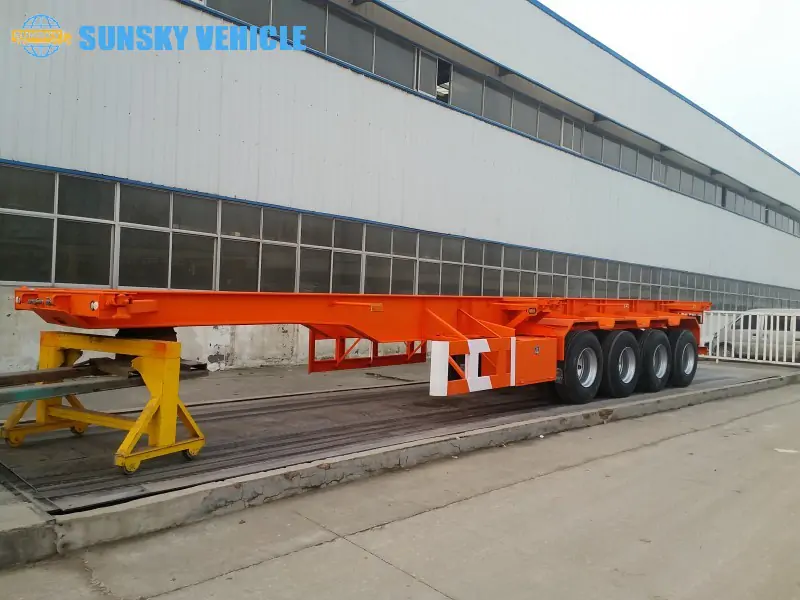
2. Axle Configurations & Load Capacity
Container chassis come in multiple axle configurations to support different weight limits:
2-Axle Chassis
-
Typically rated for lighter loads
-
Common for 20ft containers or lighter 40ft containers
-
Suitable for short- and medium-distance haulage
3-Axle Chassis
-
The most widely used globally, balancing weight and stability
-
Ideal for heavy 40ft containers and long-distance transport
-
Provides improved braking, load distribution, and road compliance
Multi-Axle (4 Axles or more)
-
Designed for extreme heavy-duty applications
-
Often used in countries with strict axle-weight laws
-
Common for overweight cargo, bulk commodities, or specialized logistics
Regional regulations (such as U.S. FMCSA, EU axle-load laws, Africa/Middle East highway rules) often determine which axle setup is permissible.
3. Why Choosing the Right Size & Axle Configuration Matters
Load Safety & Stability
Using the correct axle count ensures proper weight distribution and reduces rollover risk.
Regulatory Compliance
Each country enforces maximum axle loads and gross vehicle weight limits—wrong configuration may lead to fines or detention.
Fuel Efficiency & Cost
Lighter chassis or optimized axle setups reduce fuel consumption and tire wear.
Cargo Type Requirements
Heavy cargo needs stronger frames and extra axles; lighter cargo favors long chassis (40–45ft) for better efficiency.
Operational Flexibility
Choosing the right chassis ensures compatibility with port equipment, weighbridges, and cross-border transport rules.
Operational & Business Models
Understanding how container chassis are operated, owned, and managed is essential for logistics companies, freight forwarders, and trucking fleets. The chassis market has evolved significantly, offering flexible business models that reduce costs and improve fleet efficiency.
1. Ownership vs. Leasing / Renting
Owning a Chassis Fleet
Advantages:
-
Full control of equipment availability
-
Ideal for high-frequency or dedicated routes
-
Long-term asset investment with predictable availability
-
Suitable for carriers with stable container volumes
Disadvantages:
-
High upfront capital expenditure
-
Requires ongoing maintenance, inspections, and storage
-
Risk of underutilization during low-season periods
Leasing or Renting (Short-term & Long-term)
Short-term Rental
-
Used during peak season, special cargo projects, or sudden volume increases
-
No long-term financial commitment
-
Ideal for small and medium-sized trucking companies
Long-term Leasing
-
Lower monthly payments compared to ownership
-
Maintenance may be included in leasing contracts
-
Preserves cash flow while ensuring availability
Advantages of Leasing:
-
Avoids large upfront costs
-
Scalable based on cargo demand
-
Reduces maintenance and compliance responsibilities
-
Perfect for companies with fluctuating cargo volumes
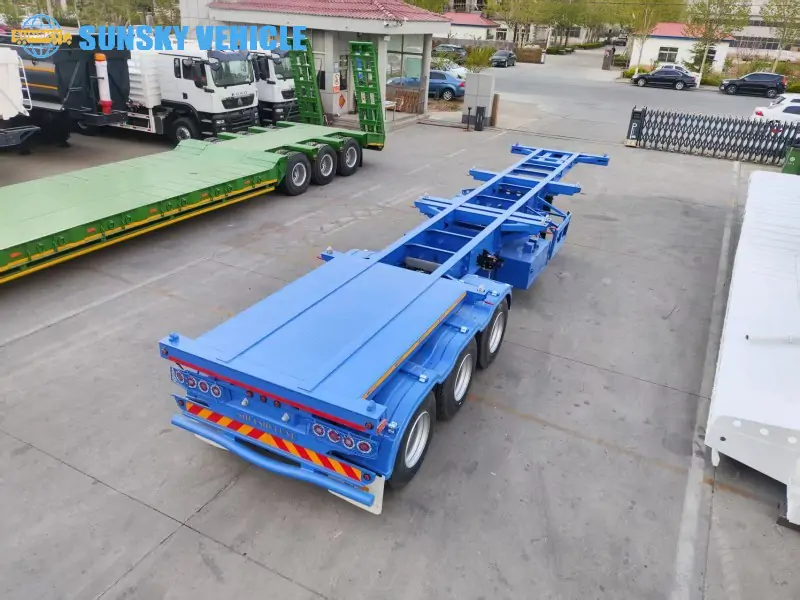
2. Flexibility of Multifunctional Chassis
Modern multifunctional chassis (e.g., extendable, combo chassis, tri-axle adjustable systems) offer major advantages:
-
Handle multiple container sizes (20ft, 40ft, 45ft)
-
Switch between different cargo types: ISO tanks, reefers, dry containers
-
Reduce total fleet size — fewer chassis needed to handle various operations
-
Higher asset utilization thanks to versatile design
-
Ideal for mixed-load trucking companies or intermodal operators
This flexibility allows logistics companies to standardize their fleet, improve dispatching efficiency, and reduce empty return mileage.
3. Cost Efficiency: How Leasing & Multifunction Chassis Reduce Total Cost
Reduced Capital Investment
Leasing shifts container chassis from a capital expense (CAPEX) to an operational expense (OPEX), improving cash flow.
Lower Maintenance Cost
Many leasing agreements include preventive maintenance and inspections—removing the burden from the fleet owner.
Higher Utilization Rates
A multifunction chassis can replace multiple fixed-size chassis, reducing warehouse space, idle equipment, and spare parts inventory.
Operational Agility
Fast access to extra chassis during peak seasons helps companies avoid demurrage, detention fees, and port delays.
Reduced Total Cost of Ownership (TCO)
Combining leasing with a multifunction chassis model often results in:
-
Fewer assets to manage
-
Lower repair expenses
-
Reduced downtime
-
Faster response to market changes
Benefits of Using a Container Chassis
Container chassis play a fundamental role in the global logistics ecosystem. Their efficiency, standardization, and robust engineering provide significant advantages for transport companies, freight forwarders, and intermodal operations. Below are the key benefits.
1. Improved Logistics Efficiency
A well-designed container chassis dramatically increases the speed and efficiency of cargo operations:
-
Faster loading and unloading using standardized twist-lock points
-
Reduced waiting time at ports, depots, and warehouses
-
Seamless container transfers between ships, rail, and trucks
-
Better yard maneuverability, especially with short 20ft chassis
Because container sizes are standardized (ISO), chassis can connect instantly with handling equipment such as reach stackers, cranes, and lift trucks, accelerating the entire logistics workflow.
2. Cost Savings & Higher Asset Utilization
Container chassis help companies reduce overall operational costs:
-
Fewer equipment types needed thanks to interchangeable ISO container sizes
-
Higher utilization rates—one chassis can serve multiple shipment types
-
Multifunction or extendable chassis reduce fleet size, lowering investment
-
Lower fuel and maintenance costs through lightweight, optimized designs
For businesses with fluctuating shipping volumes, using a chassis fleet (or renting when needed) avoids the expense of specialized trailers and maximizes cost efficiency.
3. Enhanced Safety
Container chassis are engineered for secure, stable, and compliant transport:
-
Strong steel frames ensure structural stability under heavy loads
-
Twist-lock mechanisms secure containers firmly during long-distance hauling
-
ABS braking systems improve control during emergency braking
-
LED lighting and reflective markings increase visibility at night
-
TPMS (tire pressure monitoring) helps prevent blowouts and overheating
These safety features reduce the risk of accidents, cargo damage, and roadside downtime—critical for both domestic and international transport.
4. Support for Global & Intermodal Transport
Container chassis are built around ISO container standards, making them ideal for multimodal logistics:
-
Seamlessly transfer containers from ship → port → truck → rail → warehouse
-
Compatible with global port machinery and handling equipment
-
Simplifies customs procedures and cross-border operations
-
Essential for long-haul, intercontinental, and door-to-door freight transport
This intermodal compatibility is the foundation of modern supply chains—allowing safe, fast, and consistent transportation across countries and continents.
How to Choose the Right Chassis Trailer
Selecting the right container chassis is crucial for ensuring safety, efficiency, and cost-effectiveness in your logistics operations. Several factors should be carefully considered before purchasing or leasing a chassis trailer.
1. Choose Based on Container Size (20ft / 40ft / 45ft)
-
20ft Chassis: Ideal for dense, heavy cargo or frequent short-haul operations. Offers high maneuverability in ports and tight yards.
-
40ft Chassis: The most common choice, compatible with standard 40ft containers and high-cube (HC) units. Suitable for long-distance and intermodal transport.
-
45ft Chassis: Designed for high-cube containers used in e-commerce, light cargo, or specialized shipments. Requires longer wheelbase and reinforced frame.
Tip: Always match your chassis length to the container size to ensure load stability, safe operation, and regulatory compliance.
2. Choose Axle Configuration According to Road & Regional Regulations
-
2-Axle Chassis: Suitable for lighter loads or 20ft containers; ideal for short-distance transport.
-
3-Axle Chassis: Standard for heavy 40ft containers; provides balance between load capacity and stability.
-
Multi-Axle Chassis (4+ Axles): Required for oversized or overweight cargo, ensuring compliance with local axle-weight laws.
Tip: Check local road regulations in your operating region, including maximum gross vehicle weight, axle limits, and bridge/road restrictions.
3. Choose Based on Operational Mode (Ownership vs Leasing)
-
Ownership: Offers full control and long-term availability; suitable for high-frequency operations. Requires upfront capital and maintenance responsibility.
-
Leasing / Renting: Flexible for seasonal demand, short-term projects, or fluctuating volumes. Reduces upfront investment and maintenance burden.
Tip: Evaluate your shipping volumes, operational frequency, and cash flow before deciding between buying and leasing.
4. Consider Maintenance, Durability, and Lifespan
-
Materials: High-tensile steel and corrosion-resistant coatings increase longevity.
-
Manufacturing Quality: Robotic welding, precision fabrication, and modular design reduce defects and simplify maintenance.
-
Maintenance Requirements: Some chassis come with easier access to brake systems, twist locks, and suspension for faster inspections.
Tip: Investing in durable, high-quality chassis reduces downtime, repair costs, and total cost of ownership over the long term.
Frequently Asked Questions About Container Chassis
Here are some common questions logistics operators, fleet managers, and freight companies ask about container chassis.
1. How does a chassis secure a container? (Twist-Lock Mechanism)
A container chassis uses twist-locks—special locking devices located at the corners of the chassis—to secure containers in place.
-
The ISO container corner castings fit into the twist-locks.
-
By twisting the lock 90 degrees, the container is firmly secured to the chassis frame.
-
Some chassis offer automatic or semi-automatic twist-locks, which reduce manual handling and increase loading speed.
This mechanism prevents containers from sliding or tipping during transit, ensuring road safety and cargo protection.
2. Why use a multifunctional chassis?
A multifunctional chassis offers versatility and cost efficiency:
-
Can carry multiple container sizes (20ft, 40ft, 45ft) with adjustable twist-lock positions.
-
Capable of transporting various cargo types: dry containers, tank containers, and reefers.
-
Reduces the number of chassis needed in your fleet, improving asset utilization.
-
Ideal for logistics companies with fluctuating cargo types or mixed operations.
Multifunctional chassis help companies maximize flexibility and minimize fleet investment.
3. What is the difference between 2-axle and 3-axle chassis?
-
2-Axle Chassis:
-
Best for lighter cargo or 20ft containers.
-
More maneuverable, especially in tight port areas.
-
Limited load capacity compared to 3-axle models.
-
-
3-Axle Chassis:
-
Standard for heavy 40ft or 45ft containers.
-
Provides better weight distribution and road stability.
-
Required for long-haul and intermodal transport in many countries.
-
Tip: The choice depends on container weight, road regulations, and operational routes.
4. Leasing vs Buying a Chassis — Which is more cost-effective?
Leasing / Renting:
-
Lower upfront investment
-
Flexible for seasonal or fluctuating demand
-
Maintenance may be included in the lease
Buying / Ownership:
-
Full control of chassis availability
-
Long-term investment if container volumes are stable
-
Requires higher initial capital and maintenance responsibility
Conclusion:
-
Leasing is ideal for companies with variable cargo volumes or short-term needs.
-
Ownership is better for high-volume, long-term operations where chassis utilization is consistent.
Conclusion
Container chassis, also known as chassis trailers, are essential components in modern logistics and containerized transport. They serve as the critical link between ports, terminals, rail yards, and inland destinations, enabling efficient, safe, and reliable movement of ISO containers around the world.
Choosing the right type of chassis—whether fixed, extendable, gooseneck, multifunctional, or specialized—directly impacts:
-
Cost efficiency: optimized fleet utilization, reduced capital investment, and lower maintenance expenses
-
Safety: stable structural design, secure twist-lock mechanisms, and advanced braking systems
-
Operational efficiency: faster loading/unloading, minimized downtime, and seamless intermodal transport
For logistics operators, freight companies, and trucking fleets, it is essential to assess your business needs—container sizes, load weight, operational routes, and frequency—before deciding whether to buy or lease chassis, and which chassis configuration best fits your operations.
To make the right choice and maximize your operational performance, we invite you to:
-
Contact our experts for professional advice and customized quotes
-
Download our product catalog, technical manuals, or whitepapers for detailed specifications and guidance
Investing in the right container chassis ensures your fleet operates safely, efficiently, and profitably, giving your business a competitive edge in today’s global logistics market.