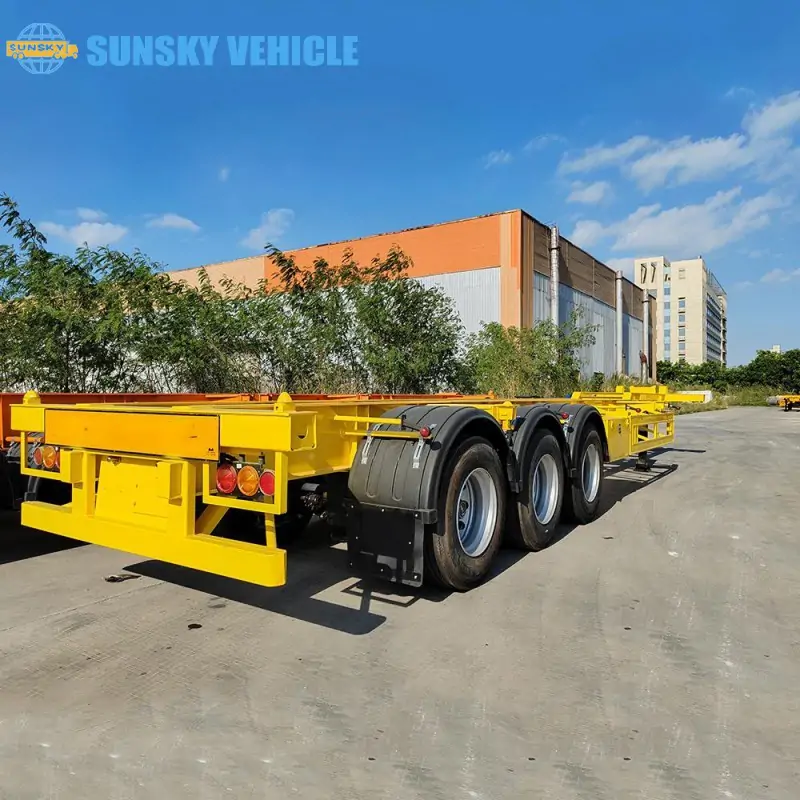
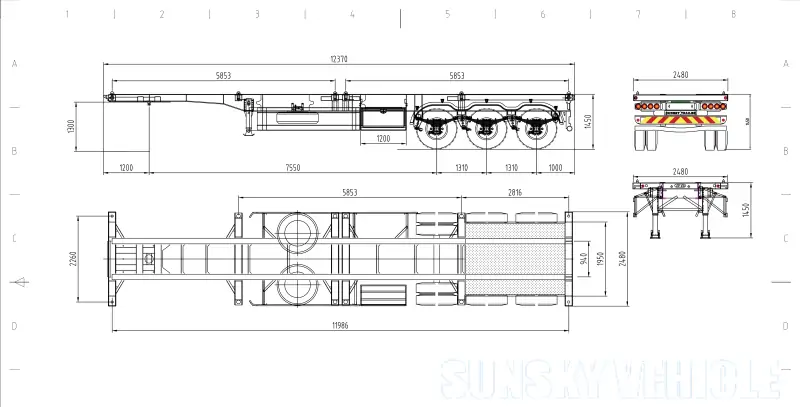
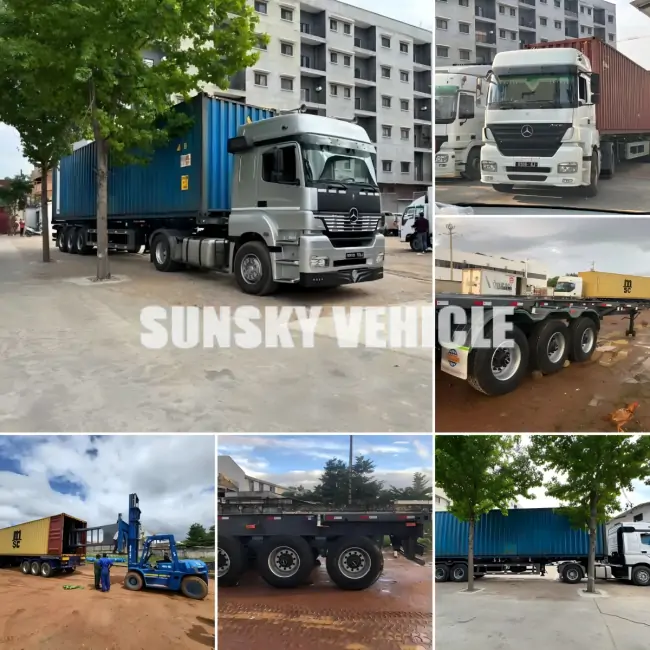
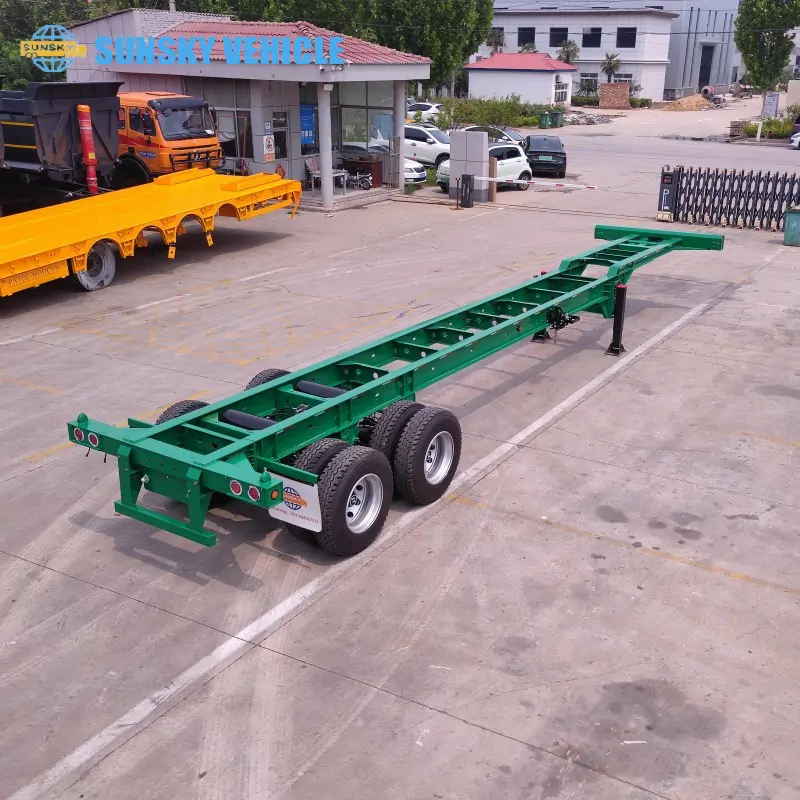
Our tri-axle gooseneck skeleton semi-trailer is the ultimate solution for safe and efficient container transport. The unique gooseneck design and FUWA air suspension provide exceptional stability and a lower center of gravity, making it ideal for heavy-duty haulage.
Gooseneck Container Trailer Specifications
Payload (kgs):
38400
Tare weight(kgs):
5600
Kingpin:
Bolt-in type 3.5” or 2”
Landing gear:
TWO-SPEED MANUAL OPERATION TYPE WITH SAND SHOE.(FUWA17INCH)
Tire size:
9.00*22.5
Rim size:
9.00*22.5
Axle:
3 Axles, 13 Tons
Suspension
FUWA three-axle air suspension
Brake system:
Dual line with Re-6 emergency relay valve, T30/30 air chamber, 46L air tank
Container locks
12 (for 1x20GP, 2x20GP, 1X40HQ)
Painting:
Two coats of anti-corrosion primer and one coat of finish painting
Accessory:
One toolbox; one set of standard tool
Robust and Durable, Achieve Exceptional Transport
Start your project today and get a high-performance semi-trailer solution tailored specifically to your unique needs.
Superior Stability and Durability for Your Container Transport Needs
When it comes to transporting valuable cargo, stability and durability are non-negotiable. Our gooseneck container trailer stands out with its heavy-duty and extra-durable design. The mainframe is built from high-tensile, low-carbon alloy Q345B steel. This material is not only strong but also designed to withstand the rigors of long-haul transport. The I-beam is welded using an advanced automatic arc-submerge process, which ensures a strong, uniform weld and guarantees the trailer’s structural integrity for years to come.
Advanced Suspension System for a Smoother, Safer Ride
A key feature of this tri-axle gooseneck trailer is its FUWA three-axle air suspension. Unlike traditional spring suspension, air suspension provides a smoother ride, reducing wear and tear on both the trailer and the cargo. This is especially crucial when transporting sensitive goods. The suspension system, combined with a total of three 13-ton axles , ensures optimal load distribution and enhanced handling, even under a full payload of 38,400 kgs.
Engineered for Versatility and Compliance
Our gooseneck skeleton semi-traileris designed to be highly versatile, capable of carrying one 20ft, one 40ft, or two 20ft containers. It comes equipped with 12 container locks to securely fasten your cargo during transit. The dual-line brake system, featuring an RE-6 emergency relay valve and T30/30 air chambers, provides reliable stopping power, ensuring safety on the road. For added convenience and compliance, the electrical system includes a 24V 7-pin ISO standard socket and a full set of lights, including a brake light, turn light, reverse light, side light, reflector, and fog light.
Robust and Durable, Achieve Exceptional Transport
Start your project today and get a high-performance semi-trailer solution tailored specifically to your unique needs.
Ready to elevate your container transport capabilities with a high-strength, efficient, and exceptionally durable skeletal trailer?
Don’t let subpar equipment compromise your deadlines or your bottom line. Our expert team is here to help you select the ideal skeletal trailer or design a custom solution that perfectly fits your business needs. Contact us today for a personalized quote or to speak directly with one of our trailer specialists. Let us provide the reliable foundation for your continued success in intermodal hauling!
Video of container chassis trailer
Robust and Durable, Achieve Exceptional Transport
Start your project today and get a high-performance semi-trailer solution tailored specifically to your unique needs.
1. What is a skeletal trailer, and what is its primary purpose?
A skeletal trailer, also widely known as a container chassis or intermodal chassis, is a specialized type of semi-trailer designed specifically for the transport of ISO shipping containers. Its name comes from its minimalist, skeletal frame—it consists of a steel frame, axles, and a suspension system but lacks a conventional cargo deck. The primary purpose of a skeletal trailer is to securely and efficiently haul standardized shipping containers of various sizes (e.g., 20ft, 40ft, 45ft) between different intermodal hubs such as ports, rail yards, and warehouses. By using a minimalist design, it is optimized to reduce tare weight, allowing for maximum payload capacity and improved fuel efficiency, making it the most cost-effective and secure solution for container transport.
2. What are the key advantages of using a skeletal trailer for container transport?
Using a skeletal trailer for container transport offers several key advantages over other trailer types. First and foremost is payload optimization. Due to its lightweight, stripped-down design, a skeletal trailer has a low tare weight, allowing you to carry a heavier container legally, which is crucial for maximizing efficiency and profitability. Second is security. The trailer is equipped with specialized twist locks at specific positions that fit directly into the corners of an ISO container, creating an extremely secure and rigid connection. This prevents the container from shifting during transit, enhancing safety. Third is efficiency. The design is perfectly suited for quick loading and unloading at ports and rail terminals, as it is engineered to handle the container’s weight directly, without needing a flatbed or other deck. This streamlined operation makes the skeletal trailer an indispensable tool for fast-paced logistics and intermodal chassis operations.
3. How do skeletal trailers accommodate different container sizes like 20ft, 40ft, and 45ft?
Skeletal trailers, and the broader category of container chassis, are engineered with a versatile design to handle a range of ISO container sizes. A standard 40ft skeletal trailer will have twist locks placed to secure a single 40ft container. However, these trailers often have additional twist lock positions located in the middle of the frame to accommodate a single 20ft container. For transporting two 20ft containers, some container skeletal trailers are designed with multiple sets of locks to securely hold both. For longer 45ft containers, there are specialized extendable skeletal trailers that can be mechanically lengthened to the required size and then retracted for better maneuverability when hauling shorter containers or when empty. This adaptability ensures that a single type of container transport trailer can serve a variety of logistical needs, making it a highly flexible asset for any fleet involved in container hauling.
4. What are the essential safety features of a skeletal trailer?
The safety of a skeletal trailer is paramount, and several key features are integrated to ensure secure operation. The most critical features are the twist locks. These heavy-duty, ISO-compliant locking mechanisms engage with the container’s corner castings to prevent any longitudinal or lateral movement, even under extreme road conditions. The trailer’s frame itself is built from high-tensile steel, providing exceptional structural integrity and preventing bending or cracking under heavy loads. All skeletal trailers must be equipped with DOT-compliant braking systems, including ABS (Anti-lock Braking System), which prevents wheel lockup during hard braking and maintains vehicle control. A robust lighting system with sealed LED lights is also essential for maximum visibility in all weather conditions. Lastly, proper axle placement and kingpin settings are engineered to optimize weight distribution, providing stability and preventing rollover risk. These features work in concert to make the skeletal trailer a safe and reliable choice for intermodal transport.
Chassis trailer application scenarios
Intermodal Transportation / Container Haulage: This is the most common and primary use. Skeleton trailers are the backbone of intermodal logistics, connecting different modes of transport (ship, rail, road).
Port and Terminal Operations: Within port areas, skeleton trailers are essential for moving containers efficiently between stacking yards, quaysides (for loading/unloading from ships), and customs inspection points.
Logistics and Supply Chain Management: Companies involved in importing and exporting goods that utilize containerized shipping rely heavily on skeleton trailers to get products from the port of entry to their final destination or vice-versa.
Connect with us
Ready to partner? We’re convinced Sunsky Vehicle is your best choice! Reach out through the form or by phone.
*Our team will answer your inquiries within 24 hours.
*Your information will be kept strictly confidential.