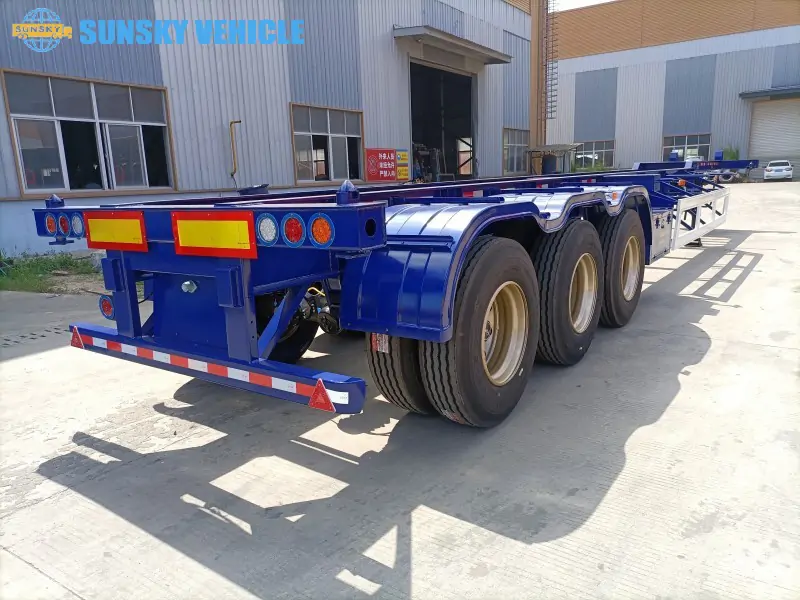
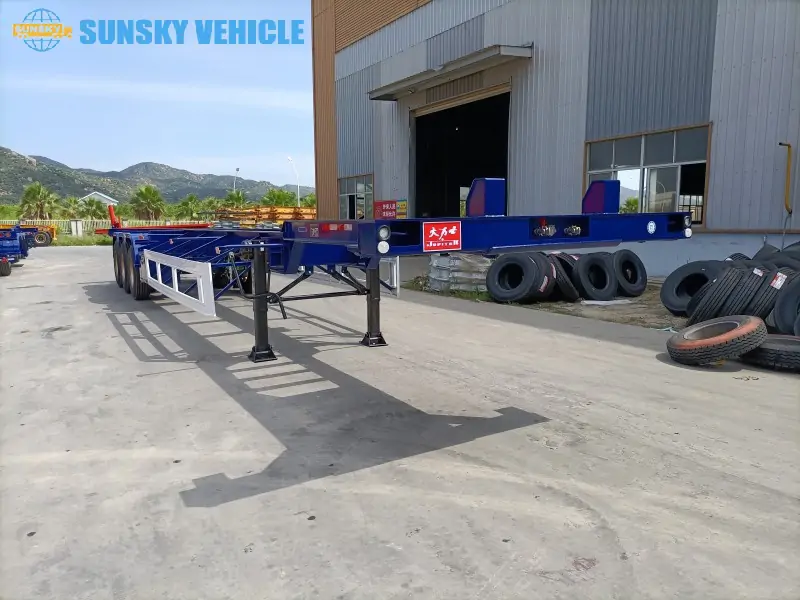
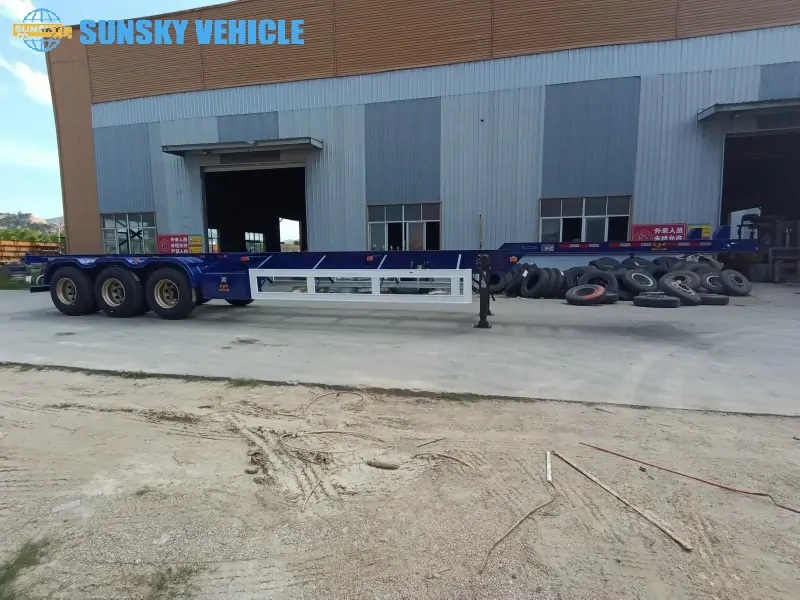
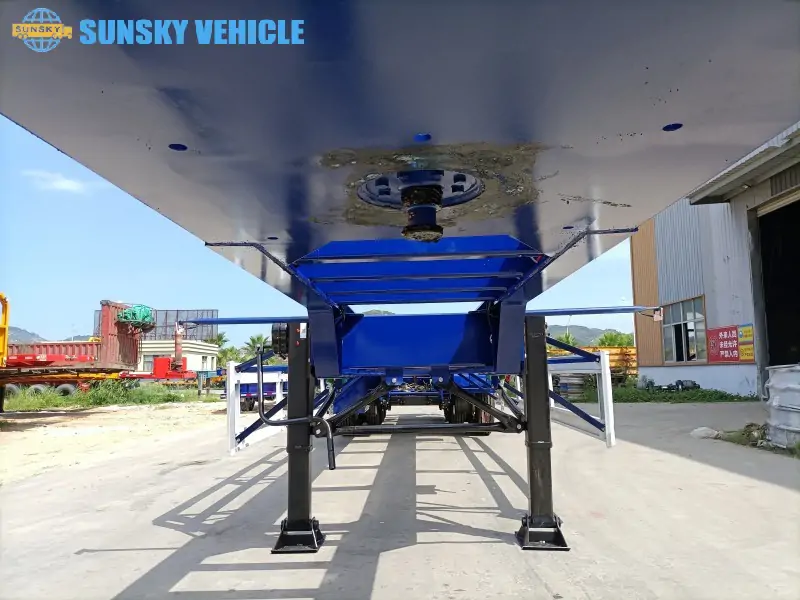
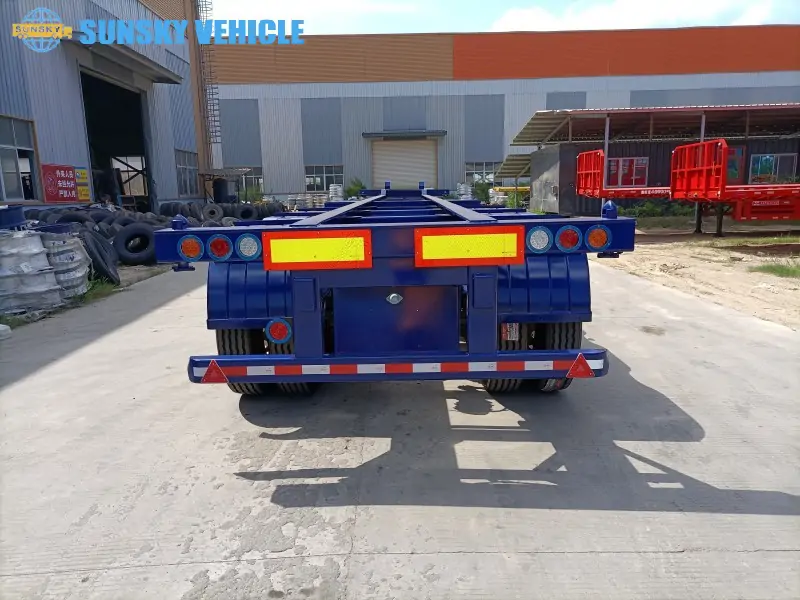
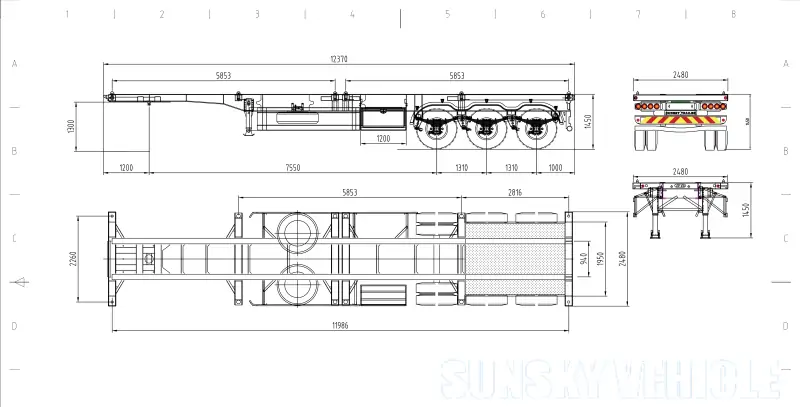
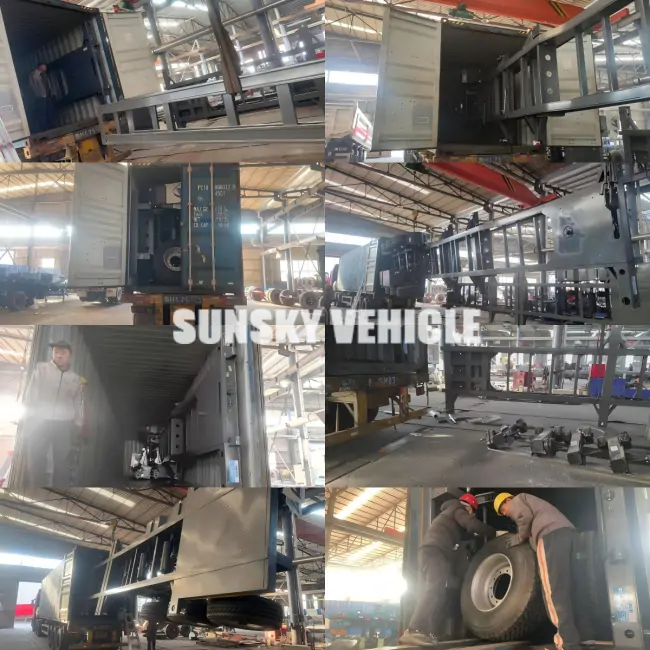
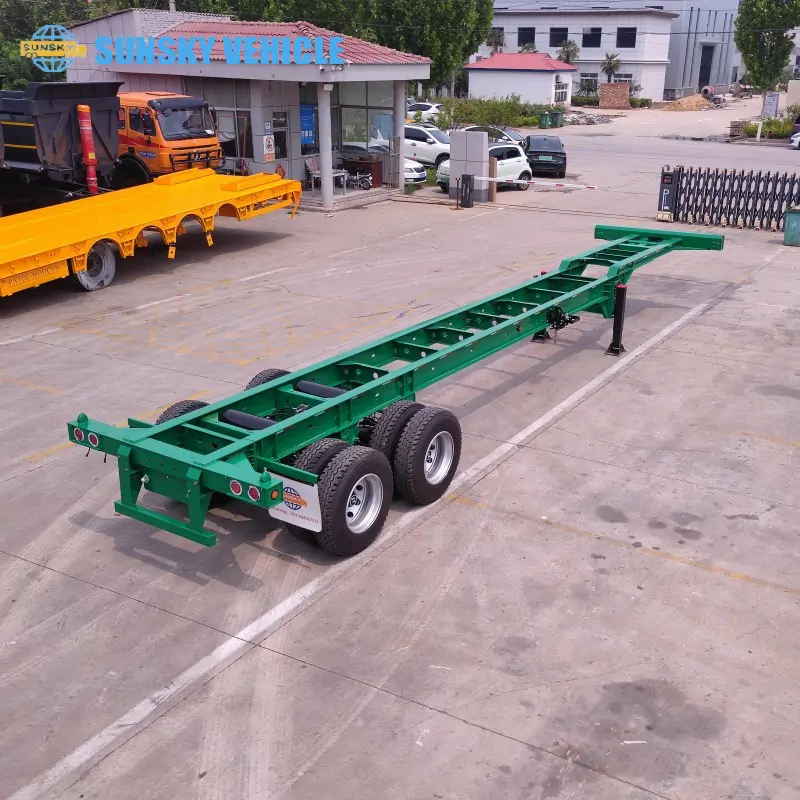
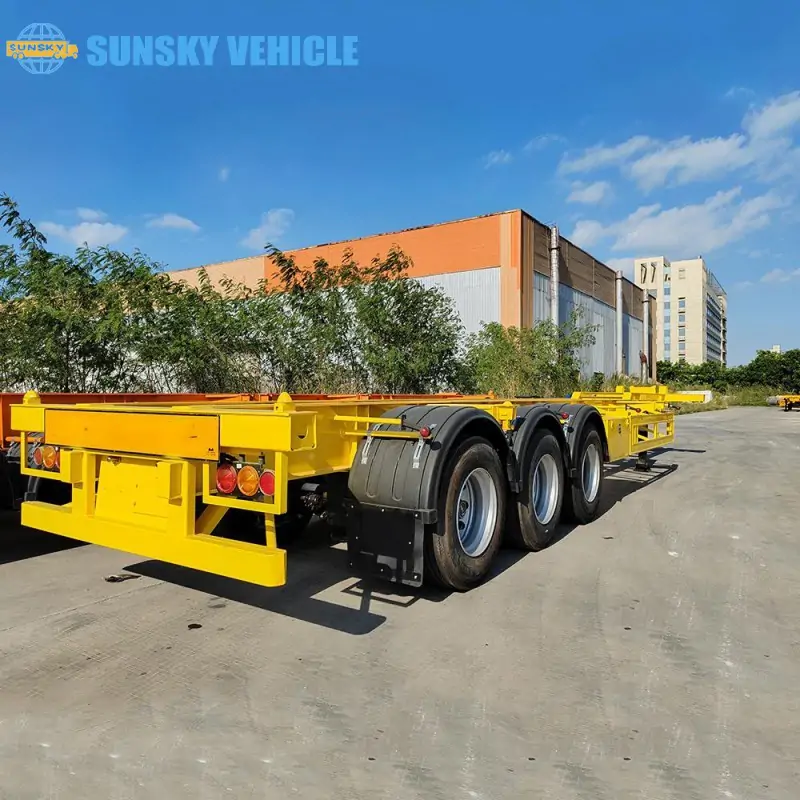
Engineered for superior performance, our 45ft container trailer is built to handle the toughest logistics challenges. With a robust Q345B steel frame and a 34,400 kg payload, it’s the ideal choice for efficient and reliable container transport.
45ft Container Trailer Specifications
Tare weight (kg)
5,600
Payload (kg)
34,400
G.V.W.R. (kg)
40,000
Paint
Two coats of anti-corrosion primer, one coat of finish painting
Landing gear
Fuwa brand 19”
Kingpin
2’’, exchangeable
Brake system
Wabco relay valve, T/30 air chamber
Tires
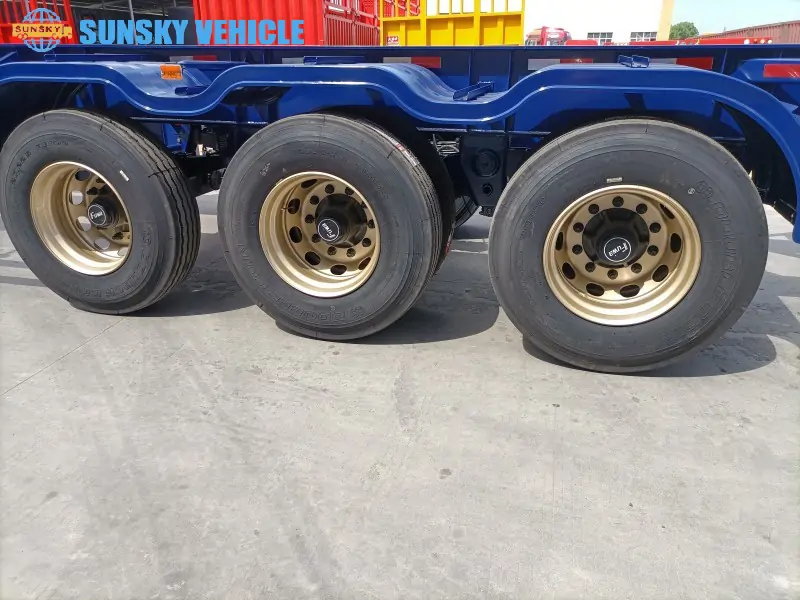
13 sets, double-coin 11R22.5 RR202
Rims
13 sets, 8.25-22.5
Toolbox
One set on right of trailer
Spare tire carrier
Equipped 2 sets per chassis
Mudguard
Steel
Robust and Durable, Achieve Exceptional Transport
Start your project today and get a high-performance semi-trailer solution tailored specifically to your unique needs.
Unmatched Durability: The Foundation of Our 45ft Container Trailer
Durability is at the core of our FJC9400TJZG 45ft container trailer. The main beam is constructed from high-quality Q345B steel, known for its high tensile strength and resilience. This robust material ensures the trailer can withstand the stresses of heavy-duty transport. The flanges and web are precisely engineered with a 14/6/16 mm thickness and a one-piece web design, further enhancing the trailer’s structural integrity and longevity.
Engineered for Optimal Performance and Safety
This 45ft container semi-trailer is designed for peak operational efficiency and safety. It features a mechanical suspension with 8 pieces of leaf springs (4 pieces full length), providing reliable load support and a stable ride. For braking, we’ve equipped it with a high-performance system featuring a Wabco relay valve and T/30 air chambers, ensuring responsive and consistent stopping power. The inclusion of Fuwa 13-ton axles and Double-coin 11R22.5 tires further guarantees durability and performance.
Robust and Durable, Achieve Exceptional Transport
Start your project today and get a high-performance semi-trailer solution tailored specifically to your unique needs.
Our 45ft container trailer is more than just a piece of equipment; it’s a strategic asset for your business. Its combination of a high-strength steel frame, brand-name components like Fuwa axles and Wabco brakes, and thoughtful design features like the spare tire carriers and toolbox ensures it delivers exceptional value and reliability.
Contact our sales team today to learn more and receive a customized quote!
Video of container chassis trailer
Robust and Durable, Achieve Exceptional Transport
Start your project today and get a high-performance semi-trailer solution tailored specifically to your unique needs.
1. What is a skeletal trailer, and what is its primary purpose?
A skeletal trailer, also widely known as a container chassis or intermodal chassis, is a specialized type of semi-trailer designed specifically for the transport of ISO shipping containers. Its name comes from its minimalist, skeletal frame—it consists of a steel frame, axles, and a suspension system but lacks a conventional cargo deck. The primary purpose of a skeletal trailer is to securely and efficiently haul standardized shipping containers of various sizes (e.g., 20ft, 40ft, 45ft) between different intermodal hubs such as ports, rail yards, and warehouses. By using a minimalist design, it is optimized to reduce tare weight, allowing for maximum payload capacity and improved fuel efficiency, making it the most cost-effective and secure solution for container transport.
2. What are the key advantages of using a skeletal trailer for container transport?
Using a skeletal trailer for container transport offers several key advantages over other trailer types. First and foremost is payload optimization. Due to its lightweight, stripped-down design, a skeletal trailer has a low tare weight, allowing you to carry a heavier container legally, which is crucial for maximizing efficiency and profitability. Second is security. The trailer is equipped with specialized twist locks at specific positions that fit directly into the corners of an ISO container, creating an extremely secure and rigid connection. This prevents the container from shifting during transit, enhancing safety. Third is efficiency. The design is perfectly suited for quick loading and unloading at ports and rail terminals, as it is engineered to handle the container’s weight directly, without needing a flatbed or other deck. This streamlined operation makes the skeletal trailer an indispensable tool for fast-paced logistics and intermodal chassis operations.
3. How do skeletal trailers accommodate different container sizes like 20ft, 40ft, and 45ft?
Skeletal trailers, and the broader category of container chassis, are engineered with a versatile design to handle a range of ISO container sizes. A standard 40ft skeletal trailer will have twist locks placed to secure a single 40ft container. However, these trailers often have additional twist lock positions located in the middle of the frame to accommodate a single 20ft container. For transporting two 20ft containers, some container skeletal trailers are designed with multiple sets of locks to securely hold both. For longer 45ft containers, there are specialized extendable skeletal trailers that can be mechanically lengthened to the required size and then retracted for better maneuverability when hauling shorter containers or when empty. This adaptability ensures that a single type of container transport trailer can serve a variety of logistical needs, making it a highly flexible asset for any fleet involved in container hauling.
4. What are the essential safety features of a skeletal trailer?
The safety of a skeletal trailer is paramount, and several key features are integrated to ensure secure operation. The most critical features are the twist locks. These heavy-duty, ISO-compliant locking mechanisms engage with the container’s corner castings to prevent any longitudinal or lateral movement, even under extreme road conditions. The trailer’s frame itself is built from high-tensile steel, providing exceptional structural integrity and preventing bending or cracking under heavy loads. All skeletal trailers must be equipped with DOT-compliant braking systems, including ABS (Anti-lock Braking System), which prevents wheel lockup during hard braking and maintains vehicle control. A robust lighting system with sealed LED lights is also essential for maximum visibility in all weather conditions. Lastly, proper axle placement and kingpin settings are engineered to optimize weight distribution, providing stability and preventing rollover risk. These features work in concert to make the skeletal trailer a safe and reliable choice for intermodal transport.
Chassis trailer application scenarios
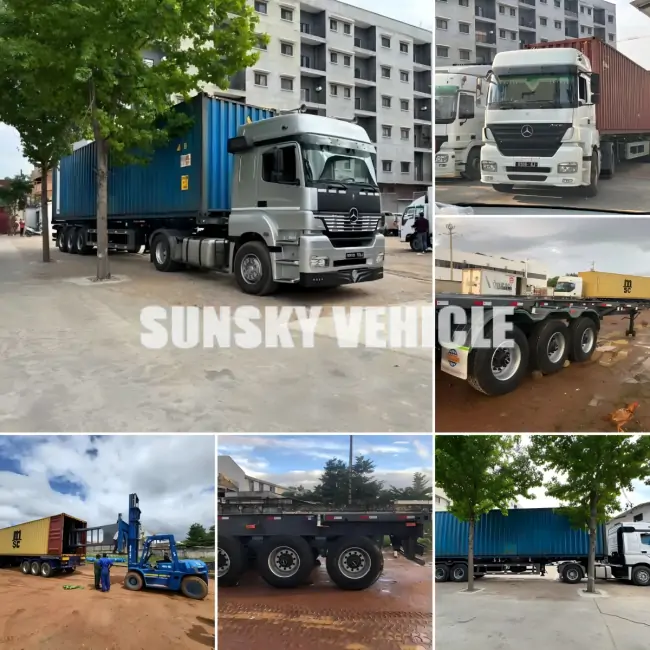
Intermodal Transportation / Container Haulage: This is the most common and primary use. Skeleton trailers are the backbone of intermodal logistics, connecting different modes of transport (ship, rail, road).
Port and Terminal Operations: Within port areas, skeleton trailers are essential for moving containers efficiently between stacking yards, quaysides (for loading/unloading from ships), and customs inspection points.
Logistics and Supply Chain Management: Companies involved in importing and exporting goods that utilize containerized shipping rely heavily on skeleton trailers to get products from the port of entry to their final destination or vice-versa.
Connect with us
Ready to partner? We’re convinced Sunsky Vehicle is your best choice! Reach out through the form or by phone.
*Our team will answer your inquiries within 24 hours.
*Your information will be kept strictly confidential.