
Choosing the right semi-trailer is essential for improving transportation efficiency, protecting cargo, and controlling operating costs. However, with so many different types of semi-trailers available, it can be difficult to determine which one best suits your business.
Some semi-trailers are designed for general cargo and construction materials, while others are specifically built for heavy machinery, liquid products, bulk materials, or shipping containers. Each type has its own structure, loading method, and transportation advantages.
In this guide, we will introduce 12 common types of semi-trailers, explain their main features, and explore the transportation scenarios for which they are best suited. Whether you operate a logistics company, construction business, agricultural enterprise, or fuel distribution fleet, this guide will help you make a more informed purchasing decision.

What Are the Different Types of Semi-Trailers?
A semi-trailer is a trailer that transfers part of its weight and cargo load to a towing tractor through a fifth-wheel coupling. It is widely used for commercial transportation because it can carry various types of cargo and can be configured for different industries.
The main types of semi-trailers include flatbed, dropside, fence, lowbed, container chassis, tipper, tanker, cement tanker, curtain-side, refrigerated, extendable, and car carrier trailers.
Before exploring each type in detail, the following table provides a quick overview.
| Semi-Trailer Type | Main Cargo | Typical Applications |
|---|---|---|
| 1. Flatbed Semi-Trailer | Steel, pipes, machinery | Construction and general freight |
| 2. Dropside Semi-Trailer | Bagged goods, building materials | General cargo transportation |
| 3. Fence Semi-Trailer | Agricultural products, bagged cargo | Agriculture and bulk freight |
| 4. Lowbed Semi-Trailer | Excavators, bulldozers, heavy machinery | Construction and mining |
| 5. Container Chassis Trailer | Shipping containers | Ports and container logistics |
| 6. Tipper Semi-Trailer | Sand, gravel, coal, ore | Mining and construction |
| 7. Tanker Semi-Trailer | Fuel, milk, edible oil, chemicals | Liquid transportation |
| 8. Cement Tanker Trailer | Cement, fly ash, powder materials | Cement plants and construction |
| 9. Curtain-Side Semi-Trailer | Pallets, packaged goods | Distribution and logistics |
| 10. Refrigerated Semi-Trailer | Frozen food, fresh produce | Cold-chain transportation |
| 11. Extendable Semi-Trailer | Long steel beams, pipes, oversized cargo | Industrial and project transportation |
| 12. Car Carrier Semi-Trailer | Cars, SUVs, light commercial vehicles | Automotive logistics |
1. Flatbed Semi-Trailer
A flatbed semi-trailer features an open, flat loading platform without fixed side walls or a roof. Its simple structure makes it one of the most versatile types of semi-trailers for commercial transportation.

Key Features
- Open loading platform for flexible cargo arrangements.
- Supports loading from the side, rear, or top, depending on the equipment available.
- Can be equipped with container twist locks, lashing rings, and other cargo-securing accessories.
- Suitable for transporting a wide range of general and industrial cargo.
Common Transportation Scenarios
Flatbed semi-trailers are widely used to transport steel coils, steel beams, timber, pipes, construction materials, machinery, and palletized cargo that does not require a fully enclosed body.
They are particularly useful for businesses that handle different cargo types and need flexible loading options. Cranes and forklifts can make loading and unloading more efficient when the cargo and site conditions allow.
Best for: General freight, construction materials, industrial equipment, and cargo requiring flexible loading access.
If your business regularly transports construction materials or mixed cargo, a flatbed semi-trailer can be a practical starting point when evaluating trailer configurations.
2. Dropside Semi-Trailer
A dropside semi-trailer is equipped with hinged side panels that can be lowered or opened to provide easier access to the cargo platform. Compared with a standard flatbed, its side panels help contain and organize cargo during transportation.

Key Features
- Hinged side panels for convenient loading and unloading.
- Open platform suitable for different cargo sizes and shapes.
- Side panels help prevent certain types of cargo from shifting off the platform.
- Configurable with different axle arrangements, side-wall heights, and cargo-securing systems.
Common Transportation Scenarios
Dropside semi-trailers are commonly used to transport cement bags, fertilizer, agricultural products, bricks, packaged goods, and general construction materials.
For example, a building materials supplier may use a dropside trailer to deliver bagged cement and other supplies to construction sites. The side panels provide basic cargo containment while allowing workers to access the load from different directions when the panels are opened.
However, side panels are not a substitute for proper cargo securing. Straps, chains, or other suitable restraints may still be required.
Best for: General cargo, bagged products, construction supplies, and businesses that need flexible side access.
3. Fence Semi-Trailer
A fence semi-trailer features an open cargo platform surrounded by relatively tall railings or fence-style side structures. Depending on the design, the fence may be removable or configurable to accommodate different cargo requirements.

Key Features
- Fence-style sides help contain cargo during transportation.
- Open structure allows ventilation and visual inspection.
- Suitable for cargo that benefits from additional side containment.
- Can be configured for different cargo heights and operating requirements.
Common Transportation Scenarios
Fence semi-trailers are frequently used to transport agricultural produce, bagged fertilizer, animal feed, grain in suitable packaging, and other goods that require side containment.
In agricultural regions, they can support the transportation of farm supplies and harvested products between farms, warehouses, processing facilities, and distribution centers.
The exact fence height and cargo arrangement should be selected according to the dimensions, weight, and securing requirements of the goods.
Best for: Agricultural logistics, bagged cargo, farm supplies, and general freight requiring fence-style containment.
4. Lowbed Semi-Trailer
A lowbed semi-trailer, also known as a lowboy trailer in some markets, is designed with a low loading deck to transport heavy, tall, or oversized machinery.
Its lowered platform helps reduce the overall height of the loaded vehicle, which is particularly important when moving large equipment under bridges or along routes with height restrictions.

Key Features
- Low loading deck for transporting tall equipment.
- Heavy-duty frame designed for specified concentrated and distributed loads.
- Available with different axle configurations according to the required load and applicable regulations.
- May feature loading ramps, detachable goosenecks, or other specialized loading systems.
Common Transportation Scenarios
Lowbed semi-trailers are widely used in construction, mining, infrastructure development, and industrial projects.
Typical cargo includes excavators, bulldozers, wheel loaders, road rollers, drilling equipment, and other heavy machinery that cannot be transported efficiently on a standard flatbed.
For example, a mining contractor may use a lowbed trailer to move an excavator between mining sites. The low deck can help reduce loaded height, while suitable ramps and securing equipment support safe loading and transportation.
Before purchasing, buyers should consider equipment weight, track width, ground clearance, loading method, and route restrictions.
Best for: Heavy construction machinery, mining equipment, industrial equipment, and oversized project cargo.
5. Container Chassis Semi-Trailer
A container chassis semi-trailer, also called a skeletal container trailer, is specifically designed to carry standardized shipping containers. Instead of using a full loading platform, it typically consists of a structural frame fitted with container locking devices.

Key Features
- Lightweight skeletal structure compared with many full-deck designs.
- Twist locks secure compatible shipping containers to the chassis.
- Available in configurations for different container lengths and combinations.
- Designed to work with container handling equipment at ports, terminals, and depots.
Common Transportation Scenarios
Container chassis trailers are essential for container transportation between seaports, inland container depots, warehouses, factories, and distribution centers.
Depending on the configuration, they may transport 20-foot, 40-foot, or other compatible container formats. Extendable or specialized chassis designs can accommodate additional container configurations where permitted.
For international logistics operators, choosing the correct chassis configuration helps improve compatibility with the containers and handling systems used in their supply chain.
Best for: Shipping container transportation, port logistics, container depots, and intermodal freight operations.
6. Tipper Semi-Trailer
A tipper semi-trailer, also known as a dump semi-trailer, uses a hydraulic lifting system to raise its cargo body and discharge bulk materials. It is designed for operations where fast unloading is important.

Key Features
- Hydraulic tipping mechanism for unloading bulk materials.
- Reinforced cargo body designed for specified materials and loading conditions.
- Available in different body volumes and axle configurations.
- Suitable for repeated loading and unloading cycles in demanding environments.
Common Transportation Scenarios
Tipper semi-trailers are widely used in construction, mining, quarrying, and infrastructure projects.
Common cargo includes sand, gravel, crushed stone, coal, ore, and construction waste, depending on the trailer’s design and operating conditions.
For example, a construction company may use a tipper trailer to transport sand from a quarry to a building site. Once positioned on a suitable unloading surface, the hydraulic system raises the body to discharge the material.
Buyers should consider the density and abrasiveness of the cargo, body volume, hydraulic system, ground conditions, and axle-load limits. A larger body does not necessarily mean a higher legal payload.
Best for: Bulk materials, mining operations, quarry transportation, and construction projects requiring hydraulic unloading.
7. Tanker Semi-Trailer
A tanker semi-trailer is designed to transport liquid cargo in a dedicated tank body. Different tanker designs are engineered for different products, so material compatibility, tank construction, and unloading equipment are critical purchasing considerations.

Key Features
- Enclosed tank body for liquid transportation.
- Available in different capacities, materials, and compartment configurations.
- May include pumps, valves, discharge piping, and specialized safety equipment.
- Can be designed for fuel, food-grade liquids, chemicals, or other compatible products.
Common Transportation Scenarios
Tanker semi-trailers are used in fuel distribution, food processing, chemical transportation, and industrial supply chains.
Common applications include transporting diesel, gasoline, edible oil, milk, and certain industrial liquids. However, a tanker intended for one product should not automatically be assumed suitable for another.
For example, a stainless steel milk tanker requires appropriate hygienic design and cleaning arrangements. A fuel tanker requires suitable materials, fittings, and safety features for the specific petroleum products it carries.
Buyers should confirm the cargo’s chemical properties, temperature requirements, cleaning procedures, and applicable transportation regulations before selecting a tanker.
Best for: Fuel distribution, food-grade liquid transport, industrial liquids, and other compatible bulk liquids.
8. Cement Tanker Semi-Trailer
A cement tanker semi-trailer, often called a powder tanker or bulk cement tanker, is designed to transport dry bulk powders in an enclosed tank. Many models use pneumatic equipment to discharge the material into storage silos.

Key Features
- Sealed tank designed to contain dry bulk materials.
- Pneumatic discharge system available on many configurations.
- Specialized tank structure and piping for powder handling.
- Designed to reduce exposure to moisture and material loss during transportation.
Common Transportation Scenarios
Cement tanker trailers are widely used by cement manufacturers, ready-mix concrete suppliers, construction material distributors, and industrial powder suppliers.
Typical cargo includes cement, fly ash, lime powder, and other compatible dry bulk materials.
For example, a cement supplier may use a powder tanker to deliver cement from a production plant to a concrete batching plant. Pneumatic unloading can transfer the powder directly into a storage silo, reducing the need for manual handling.
When purchasing, buyers should evaluate tank capacity, material density, discharge pressure, compressor compatibility, unloading time, and cleaning requirements.
Best for: Cement distribution, concrete production, fly ash transportation, and dry bulk powder logistics.
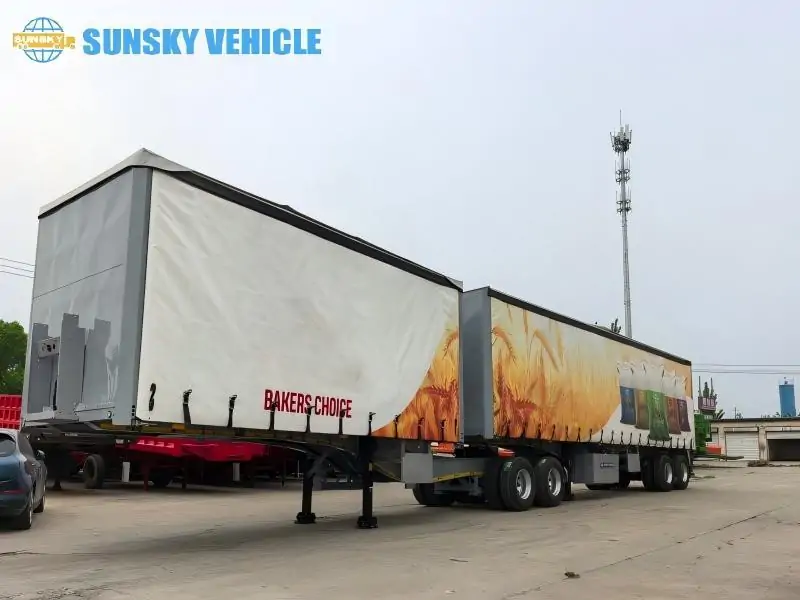
9. Curtain-Side Semi-Trailer
A curtain-side semi-trailer, also known as a curtainsider or tautliner in many markets, combines a loading platform with a roof and movable fabric side curtains.
Unlike a conventional enclosed box trailer, its curtains can be opened to provide convenient side access to the cargo.
Key Features
- Sliding curtains allow access from the sides.
- Roof and side curtains provide weather protection when properly closed and maintained.
- Supports efficient forklift loading at suitable facilities.
- Suitable for transporting a wide range of palletized and packaged goods.
Common Transportation Scenarios
Curtain-side semi-trailers are commonly used in general freight, retail distribution, manufacturing, and regional logistics.
Typical cargo includes packaged food, household products, building materials, palletized goods, and industrial components.
For example, a distribution company may use a curtain-side trailer to collect palletized products from several suppliers. Side access can make loading and unloading more convenient when multiple delivery points are involved.
Although curtains provide weather protection, they should not automatically be treated as equivalent to a fully sealed, rigid, or theft-resistant box body.
Best for: Palletized cargo, general freight, retail distribution, and operations requiring frequent side loading.
10. Refrigerated Semi-Trailer
A refrigerated semi-trailer, commonly known as a reefer trailer, features an insulated cargo body and a refrigeration system designed to maintain specified cargo temperatures.
It is particularly important for goods that can deteriorate when exposed to unsuitable temperatures.

Key Features
- Insulated cargo compartment.
- Refrigeration equipment selected for the required operating range.
- Temperature monitoring options for improved cargo management.
- Available in different configurations, including designs for multiple temperature zones.
Common Transportation Scenarios
Refrigerated semi-trailers are used in food distribution, agriculture, pharmaceutical logistics, and other temperature-sensitive supply chains.
Common cargo includes frozen meat, seafood, dairy products, fresh fruit, vegetables, and certain pharmaceutical products.
For example, a food distributor may use a refrigerated trailer to transport frozen products from a processing facility to regional distribution centers.
The correct operating temperature depends on the product. Buyers should evaluate the required temperature range, insulation performance, door-opening frequency, ambient conditions, and refrigeration capacity.
Best for: Frozen food, fresh produce, dairy products, and other temperature-sensitive cargo.
11. Extendable Semi-Trailer
An extendable semi-trailer features a loading platform that can be lengthened to accommodate cargo that exceeds the dimensions of a standard trailer deck.
Depending on the model, the extension mechanism may use sliding structural sections or other specialized arrangements.
Key Features
- Adjustable deck length for different cargo dimensions.
- Reinforced structure designed for specified load distributions.
- May include specialized supports and cargo-securing points.
- Requires careful planning for loaded dimensions and axle-load distribution.
Common Transportation Scenarios
Extendable semi-trailers are used in infrastructure construction, energy projects, steel transportation, and other industries that handle long or oversized products.
Typical cargo includes long steel beams, pipes, structural components, utility poles, and certain wind energy components.
For example, a steel manufacturer may need to transport long structural beams that cannot fit safely on a standard flatbed. An extendable trailer can provide the required deck length when configured appropriately.
Before purchasing, buyers should verify the maximum extended length, load distribution, permitted vehicle dimensions, turning requirements, and any special permits required for the intended routes.
Best for: Long industrial products, structural steel, pipes, and oversized project cargo.
12. Car Carrier Semi-Trailer
A car carrier semi-trailer is specially designed to transport passenger vehicles and other compatible automobiles. Many designs use multiple loading decks to carry several vehicles in one trip.

Key Features
- Specialized vehicle support platforms and loading ramps.
- Multiple deck levels on many configurations.
- Adjustable vehicle positions on suitable models.
- Securing systems designed to reduce vehicle movement during transportation.
Common Transportation Scenarios
Car carrier semi-trailers are widely used by automobile manufacturers, vehicle distributors, rental companies, dealerships, and vehicle logistics providers.
Typical cargo includes passenger cars, SUVs, and certain light commercial vehicles, depending on the carrier’s dimensions and load limits.
For example, an automobile distributor may use a multi-level car carrier to deliver new vehicles from a port or assembly plant to regional dealerships.
The right configuration depends on vehicle dimensions, ground clearance, total loaded weight, loading equipment, and the permitted dimensions of the complete vehicle combination.
Best for: Automotive distribution, vehicle imports, dealership deliveries, and fleet transportation.
Which Type of Semi-Trailer Is Best for Different Cargo?
Choosing the right semi-trailer starts with understanding the cargo you need to transport. Different goods have different requirements for loading, unloading, weight distribution, weather protection, and transportation safety. Selecting a trailer that matches your cargo can improve operational efficiency and help reduce unnecessary transportation costs.
Shipping Containers: Container Chassis Semi-Trailer
A container chassis semi-trailer is designed to transport standardized shipping containers between ports, warehouses, factories, and inland container depots. It uses twist locks to secure compatible containers during transportation.
When choosing a container chassis trailer, consider whether you primarily transport 20ft or 40ft containers, whether you need a fixed or extendable chassis, and what axle configuration is suitable for your cargo weight and local road regulations.
Recommended trailer: Container chassis semi-trailer.
Excavators and Heavy Machinery: Lowbed Semi-Trailer
Excavators, bulldozers, wheel loaders, and other heavy equipment often require a lowbed semi-trailer. Its low loading deck helps accommodate tall machinery and can reduce the overall height of the loaded vehicle.
Before purchasing a lowbed trailer, check the machine’s operating weight, track width, ground clearance, and loading method. The trailer’s deck dimensions, ramps, axle capacity, and gooseneck configuration should match the equipment being transported.
For particularly heavy machinery, verify the load distribution and the legal axle loads for the intended routes.
Recommended trailer: Lowbed semi-trailer or detachable gooseneck lowbed trailer, depending on the machinery and loading requirements.
Diesel and Other Liquid Fuels: Fuel Tanker Semi-Trailer
Fuel transportation requires a tanker specifically designed and approved for the intended petroleum products. A fuel tanker semi-trailer may include dedicated compartments, valves, discharge equipment, and safety features appropriate to its design.
When selecting a fuel tanker, consider the required tank capacity, product compatibility, compartment arrangement, unloading method, and applicable hazardous-goods regulations. The tank materials, fittings, and operating procedures must be suitable for the fuel being transported.
A general-purpose liquid tanker should not automatically be assumed suitable for diesel, gasoline, or other fuels.
Recommended trailer: Fuel tanker semi-trailer configured for the intended petroleum products.
Cement and Dry Powder: Bulk Cement Tanker Trailer
Cement, fly ash, and other compatible dry powders are typically transported in an enclosed bulk cement tanker trailer. Many models use pneumatic discharge systems to transfer materials directly into storage silos.
Buyers should evaluate tank capacity, cargo density, discharge pressure, compressor compatibility, and unloading time. The tank and discharge system must be suitable for the specific powder being transported.
For companies delivering cement to concrete batching plants or construction projects, an appropriately configured powder tanker can help streamline bulk material handling.
Recommended trailer: Bulk cement tanker semi-trailer or powder tanker trailer.
Sand, Gravel, and Coal: Tipper Semi-Trailer
Sand, gravel, crushed stone, coal, and other suitable bulk materials are commonly transported using tipper semi-trailers. A hydraulic lifting system raises the cargo body, allowing the material to discharge through the rear or another designated unloading arrangement.
The best configuration depends on cargo density, abrasiveness, required payload, unloading conditions, and road quality. Heavy-duty body construction may be appropriate for abrasive mining materials, while other configurations may suit lighter bulk cargo.
Buyers should also consider the unloading surface. Tipping on uneven or unstable ground can create a serious rollover risk, so the trailer must be operated according to the manufacturer’s instructions and site safety requirements.
Recommended trailer: Tipper semi-trailer or heavy-duty mining tipper, depending on the cargo and operating environment.
Steel Beams, Pipes, and General Construction Materials: Flatbed Semi-Trailer
Flatbed semi-trailers are suitable for many types of construction materials, including steel beams, pipes, timber, and machinery that can be safely secured on an open platform.
Their open design provides flexible access for cranes and forklifts. However, long or oversized products may require specialized supports, additional securing points, or an extendable trailer.
Before loading, assess the cargo’s dimensions, center of gravity, weight distribution, and restraint requirements. Always secure the load using appropriate equipment and follow applicable transportation regulations.
Recommended trailer: Flatbed semi-trailer for general construction cargo, or extendable semi-trailer for suitable long cargo.
Agricultural Products and Bagged Goods: Dropside or Fence Semi-Trailer
Agricultural products, bagged fertilizer, animal feed, and other packaged goods may be transported using dropside or fence semi-trailers.
A dropside trailer provides hinged side panels that can be lowered for easier loading and unloading. A fence semi-trailer offers taller side structures that help contain suitable cargo during transit.
The choice depends on the cargo’s packaging, dimensions, loading equipment, and need for side containment. Both designs may require additional restraints, covers, or other protective measures depending on the load and weather conditions.
Recommended trailer: Dropside semi-trailer for flexible side access, or fence semi-trailer for suitable cargo requiring higher side containment.
Palletized and Packaged Goods: Curtain-Side Semi-Trailer
Curtain-side semi-trailers are useful for transporting palletized goods, packaged products, and industrial components. Their movable side curtains provide convenient access for forklifts while offering weather protection when properly closed and maintained.
They are commonly used in distribution networks where cargo needs to be loaded or unloaded at multiple locations.
When choosing a curtain-side trailer, consider the internal dimensions, payload requirements, loading height, curtain system, and cargo-securing arrangements.
Recommended trailer: Curtain-side semi-trailer for general freight and palletized cargo.
How Do Axles, Suspension, and Road Conditions Affect Your Choice?
Selecting the right semi-trailer involves more than matching the trailer body to your cargo. The axle configuration, suspension system, and operating environment also affect load distribution, stability, maintenance requirements, and long-term operating costs.
How Does Axle Configuration Affect Payload?
The number and arrangement of axles influence how a trailer distributes its load across the road surface. Depending on the trailer design and local regulations, different axle configurations may be suitable for different payload requirements.
For example, a multi-axle lowbed trailer may be appropriate for transporting heavy construction machinery, while a standard flatbed configuration may be sufficient for many general freight applications.
However, adding axles does not automatically guarantee a higher legal payload. The permitted load depends on the trailer’s engineering, axle ratings, tire capacity, tractor unit, gross combination weight limits, and applicable road regulations.
When choosing an axle configuration, consider:
- Cargo weight: Determine the maximum expected payload and how the weight is distributed.
- Load concentration: Heavy machinery may place concentrated loads on particular sections of the deck.
- Road regulations: Confirm the permitted axle loads and vehicle dimensions in your destination market.
- Operating routes: Consider bridge restrictions, road surfaces, gradients, and access limitations.
The goal is to select a configuration that safely supports the intended cargo while complying with local requirements.
Which Suspension System Is Better: Mechanical or Air Suspension?
Mechanical and air suspension systems are both used in semi-trailers, but their suitability depends on the cargo, operating environment, maintenance resources, and budget.
Mechanical suspension
Mechanical suspension commonly uses leaf springs and a relatively straightforward mechanical structure. It is often selected for demanding operating environments where
How to Choose the Right Type of Semi-Trailer
Understanding the different types of semi-trailers is only the first step. The right purchasing decision depends on your cargo, transportation routes, operating environment, and budget.
1. Identify Your Main Cargo
Start by identifying what you transport most frequently.
- General construction materials: Consider a flatbed or dropside trailer.
- Agricultural products and bagged cargo: Consider a fence or dropside trailer.
- Heavy machinery: Consider a lowbed trailer.
- Shipping containers: Consider a container chassis trailer.
- Sand, gravel, and other bulk materials: Consider a tipper trailer.
- Fuel and other compatible liquids: Consider a tanker trailer.
- Cement and dry powders: Consider a cement tanker trailer.
- Palletized goods: Consider a curtain-side trailer.
- Frozen and temperature-sensitive products: Consider a refrigerated trailer.
- Long steel products: Consider an extendable trailer.
- Passenger vehicles: Consider a car carrier trailer.
2. Check Payload and Load Distribution
Payload capacity is one of the most important factors when choosing a semi-trailer. However, buyers should not focus on the advertised payload figure alone.
The trailer must be suitable for the cargo’s total weight, dimensions, and distribution. The tractor unit, axle configuration, tires, suspension, and fifth-wheel loading capacity must also be compatible with the intended operation.
Always confirm the permissible gross combination weight and axle-load limits for the country and routes where the vehicle will operate.
3. Consider Loading and Unloading Requirements
Different cargo types require different loading methods.
A flatbed may be suitable for crane loading, while a dropside trailer offers convenient side access. A lowbed may require ramps for loading machinery, whereas a cement tanker may require pneumatic discharge equipment.
Choosing the right loading system can reduce handling time, improve workflow, and help avoid unnecessary operating costs.
4. Evaluate Road and Operating Conditions
A trailer designed for smooth highways may not be the best option for rough construction roads or demanding mining environments.
Consider road quality, gradients, turning space, climate, travel distance, and the availability of maintenance services.
If your business operates in multiple countries, check local regulations for vehicle dimensions, axle loads, braking systems, lighting, and any required permits.
5. Compare Total Cost of Ownership
The purchase price is only one part of the total cost of operating a semi-trailer.
You should also consider fuel consumption, tire wear, maintenance requirements, spare-parts availability, downtime, and expected service life.
A trailer that closely matches your cargo and routes can help reduce unnecessary operating costs over time.
6. Work With a Reliable Semi-Trailer Manufacturer
A reliable manufacturer should be able to explain the available configurations and help you match the trailer to your actual transportation requirements.
Before placing an order, confirm the technical specifications, frame design, axle and suspension options, braking system, cargo-securing equipment, warranty terms, and after-sales support.
If you need a customized trailer, provide the manufacturer with your cargo details, operating conditions, target payload, and destination-country requirements before production begins.
Frequently Asked Questions Before Purchasing
1. What Are the Most Common Types of Semi-Trailers?
Common types include flatbed, dropside, fence, lowbed, container chassis, tipper, tanker, cement tanker, curtain-side, refrigerated, extendable, and car carrier trailers. Each type is designed for particular cargo requirements and transportation scenarios.
2. Which Type of Semi-Trailer Is Best for General Cargo?
A flatbed trailer is suitable for many types of general cargo, especially goods that can be secured on an open platform. A dropside trailer is useful when side panels are needed to help contain cargo, while a curtain-side trailer is often more suitable for palletized goods requiring weather protection and convenient side access.
The best option depends on cargo dimensions, loading equipment, and weather-protection requirements.
3. What Is the Difference Between a Flatbed and a Dropside Semi-Trailer?
A flatbed trailer has an open platform without fixed side panels, offering maximum loading flexibility. A dropside trailer has hinged side panels that can be lowered to improve side access and provide additional cargo containment.
Both can transport general cargo, but their suitability depends on the shape, packaging, and securing requirements of the load.
4. Which Semi-Trailer Is Best for Heavy Machinery?
A lowbed semi-trailer is often suitable for heavy construction machinery because its lowered deck helps accommodate tall equipment. The correct model depends on the machine’s weight, dimensions, ground clearance, loading method, and the legal restrictions along the intended route.
5. What Is the Difference Between a Tipper Trailer and a Cement Tanker Trailer?
A tipper trailer transports loose bulk materials in a cargo body that can be raised hydraulically to discharge the load. A cement tanker trailer carries dry powder in an enclosed tank and commonly uses pneumatic equipment to transfer the material into storage silos.
The two trailer types serve different cargo-handling requirements.
6. How Do I Choose the Right Semi-Trailer for My Business?
Identify your main cargo, required payload, loading and unloading methods, operating routes, and local regulations. Then compare trailer configurations, maintenance requirements, and total ownership costs. For customized applications, consult a manufacturer with your technical requirements before purchasing.
Conclusion
The 12 types of semi-trailers discussed in this guide serve different transportation needs, from general freight and construction materials to heavy machinery, bulk powders, liquids, refrigerated goods, and automobiles.
There is no single semi-trailer that is best for every business. The right choice depends on your cargo, loading requirements, road conditions, legal limits, and long-term operating costs.
By understanding the differences between these trailer types, fleet operators and transport businesses can make better purchasing decisions and select equipment that supports their transportation goals.
If you are looking for a semi-trailer for your business, start by defining your cargo and operating requirements. Comparing the available configurations with a qualified manufacturer can help you identify a suitable solution for your market.